
Call Today: (704) 931-8801
SEO is dead. That’s the message dominating online discussions today. Blog posts serve up obituaries, while Facebook and LinkedIn feeds mourn their supposed demise.
The good news is that many of these posts and articles offer promising solutions to this tried-and-true marketing channel. Some suggest you should pivot to GEO (Generative Engine Optimization- optimizing for AI Chatbots) or another similar acronym. Others suggest tools or software that can promote your business without any work on your part.
And that’s where we should be paying attention: each claim for the death of SEO is really trying to sell something else.
So, is SEO really dead- or is it just marketing?
I’ve been doing SEO for a long time now (over 15 years). Over that time, I’ve seen many changes- some very significant. Some were even earth-shattering.
For example, previously we sought any link for clients- commenting on small blogs or creating profiles on new platforms- because it worked. Not building those links was considered a disservice, given the clear benefits at the time.
And then we were attacked by a Penguin. Google rolled out an aggressive algorithm shift, meaning many of these links no longer counted. Sometimes it was worse, and Google banned many websites. Yes, even I had a client’s website banned by Penguin.
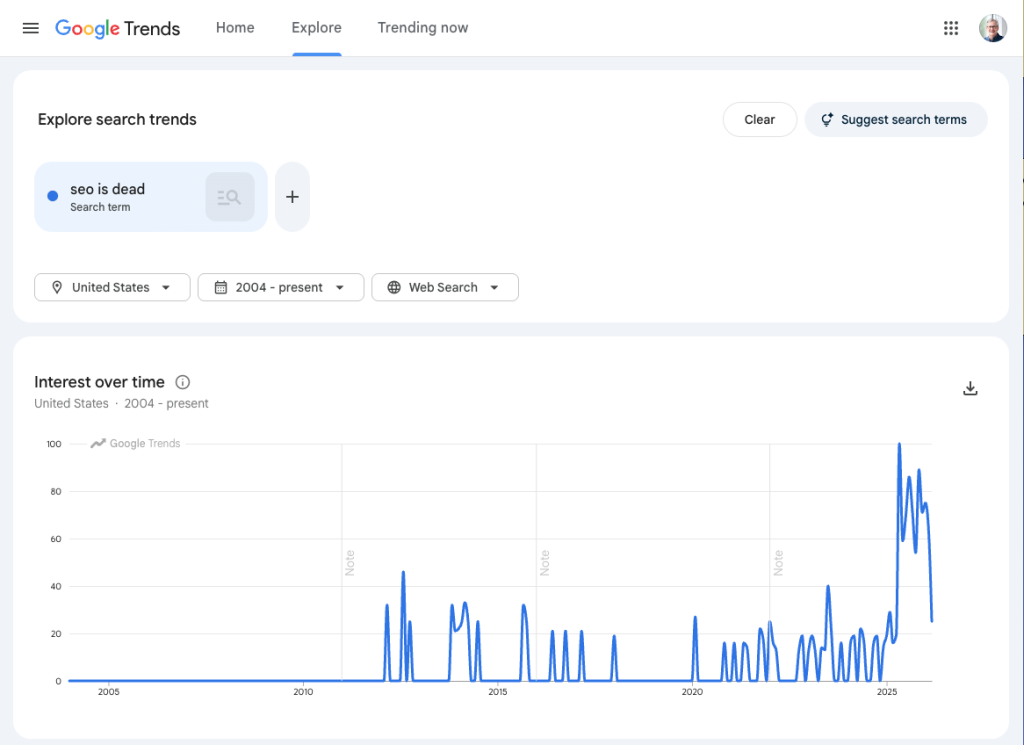
At this point, rumors began circulating about SEO’s death. What used to work is no longer working. Time to jump ship and move to other channels. You can see this in the data: if you search for “SEO is dead” on Google Trends (from 2004 to the present), you’ll see that in July 2012, people started claiming SEO was dead. If you add another term to that graph (”penguin update”), you will see its correlation.
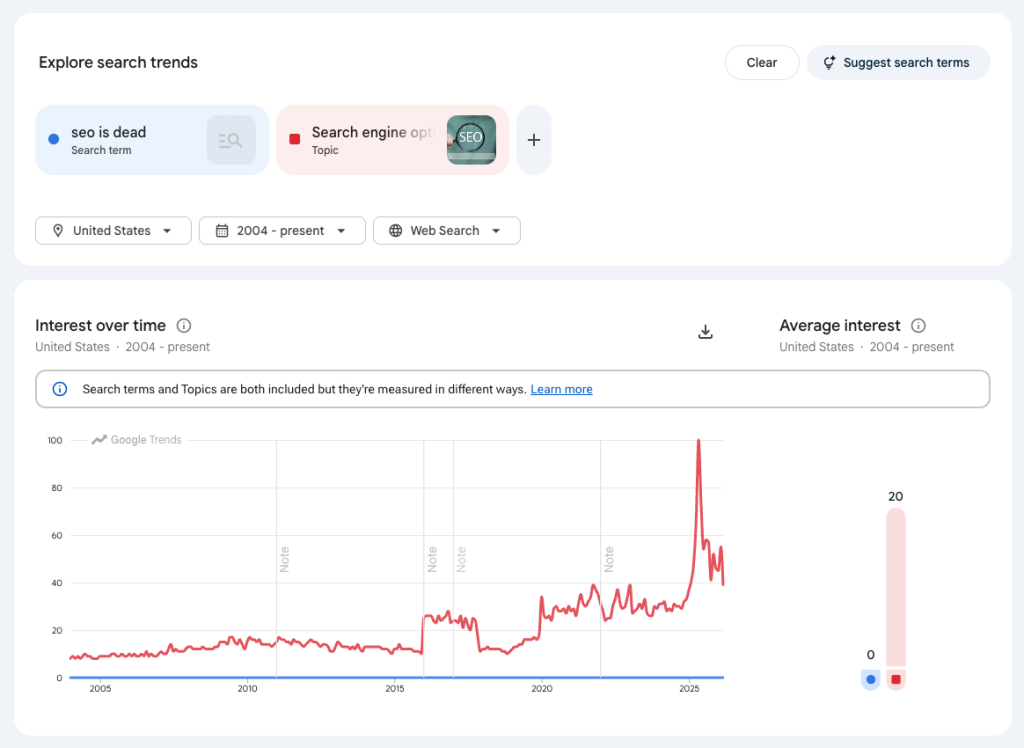
If we look even closer at the Trends graph for “SEO is dead,” patterns emerge. Over the decades, there have been repeated spikes in concern about the end of SEO. Each time, another Google algorithm animal is blamed- yet SEO survives. Comparing this Trend data with the broader interest in “Search Engine Optimization,” it is clear that more people search for SEO itself than for its supposed demise. It’s clearly not quite dead yet.
It’s within this context that HubSpot began using the phrase “Inbound marketing” to describe what it offered. “Don’t do SEO, switch to Inbound Marketing”- they would suggest. This sounded great and described a marketing channel that wasn’t about tricking Google or chasing algorithms, but about doing real marketing for your business through your website (and HubSpot’s platform).
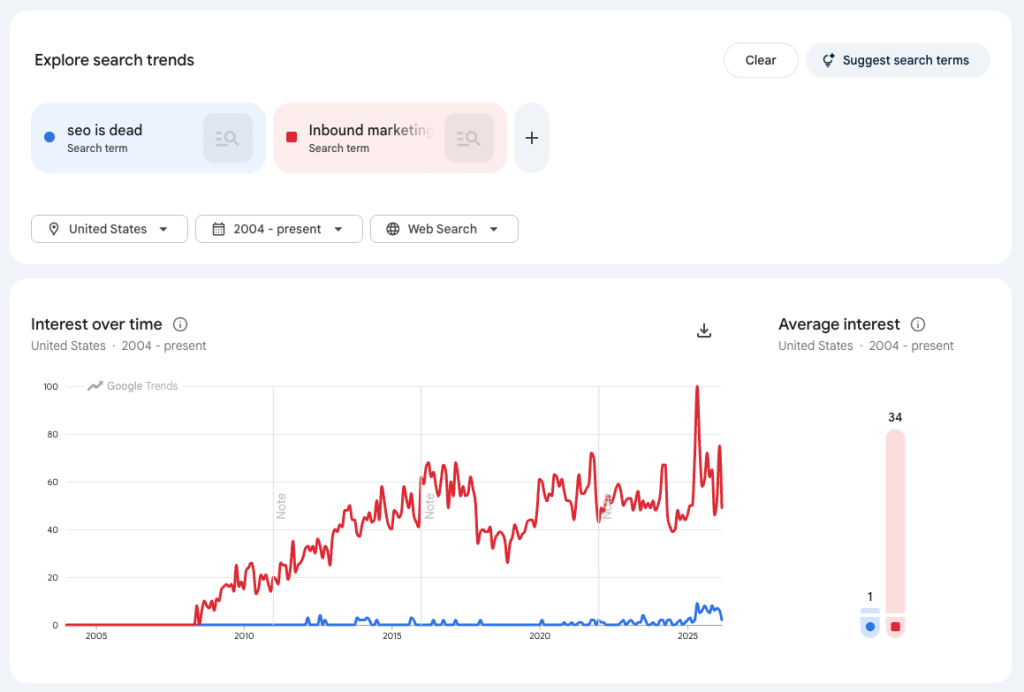
The problem is: Inbound marketing is just SEO– but rebranded.
I don’t blame HubSpot’s move. For one, SEO has always had a credibility problem. It connotes people working in dark rooms to hack Google’s algorithm and perform black magic rituals in order to trick Google into ranking your site number one. This magical connotation behind SEO made it confusing for businesses to hire people, because they didn’t know what they were paying for. Consequently, many companies would get burned- either by underperformance or website bans. If I wanted to be a serious platform to promote a client’s website, I’d want to avoid those connotations as well.
I’ve often had prospective clients ask about my ‘secret sauce’ for Google and compare it to others. They were disappointed when I said good SEO is just marketing- not trickery- so they passed on my proposal. This credibility issue is why I named my firm ‘Reliable Acorn’ and avoided labeling it solely as an SEO company.
HubSpot had another reason to focus on “inbound”- it made it sound like you needed their platform to do Inbound marketing. This is a classic and smart marketing tactic. Who wants to sell gelatin when you can be Jello? Nobody buys facial tissues, but everyone buys Kleenex. Even people who use other search engines say they’re “Googling” something. This is the benefit of HubSpot’s adoption of the “inbound” channel- and it makes sense.
Inbound marketing is just SEO. No, it’s not the scummy SEO tricks others try, but it’s SEO as marketing (true SEO). Sure, the HubSpot platform includes more than just optimization for Google- you can push to social or manage an email campaign– but those are easy (and, I’d suggest, more effective) with other simple add-ons that don’t require the significant financial commitment HubSpot does. I’d even suggest that a good SEO company would already be advising you to do the simple things HubSpot recommends (sharing your content on social and on your email list).
So, suggesting you abandon SEO to move into inbound marketing is just changing how you describe your marketing– but you’d really be doing the same thing. God forbid you actually move into the HubSpot platform (which is full of problems itself- that I won’t get into here).
Moving ahead to today, we see something similar. The rise of AI Chatbots is generating a lot of buzz these days- leading to new claims that SEO is dead. Back to our Google Trends data, and you’ll notice that, over the last year, searches for “SEO is dead” have increased significantly, to all-time highs. Maybe SEO is dead after all!
However, if you pay close attention, you might notice who is making these claims: people with something else to sell you- just like Hubspot.
Some people are selling automated tools that claim to do your SEO for you: “Fire your SEO agency,” they exclaim with confidence. While this sounds appealing, I want you to perform an experiment for me: go to your favorite Chatbot and ask it a question about a specialized topic you’re an expert in. Read the answer. I bet you’ll find that it is making some basic mistakes or incorrect assumptions. It might be “pretty good,” but is it good enough? Now, what do you think this tells you about something about which you are not an expert (SEO, for instance)? You probably think it’s “great.” Unfortunately, to an expert, it might be terrible advice.
For example, the other day I needed to change some DNS settings in order to handle emails from a domain. I thought, “I’ll ask ChatGPT how to change my DNS settings- what a great use for AI.” After a couple of hours of edits, fixes, and re-edits, my DNS was a mess. It was so bad that I had to contact my web host’s tech support, who fixed it in 5 minutes. What I thought were good ideas and productive suggestions turned out to be bad suggestions that broke things. I didn’t realize what a problem it was until I turned to an expert and found out I was taking the wrong steps.
Maybe I was giving it the wrong directions? Maybe my lack of understanding of DNS records made me ask it to do the wrong thing? Well, that’s exactly the case: crap in; crap out. I think the same thing happens with SEO and AI agents- and I’m starting to see calls from clients who followed SEO advice from AI Chatbots, and really hurt themselves. Their lack of expertise (notice: they’re not dumb; they just aren’t SEO experts) leads them to ask the wrong questions and not know whether the answers were correct.
Others claim that you need to “rank” in Chatbots rather than Google. While this sounds like valuable insight, there is a fundamental problem: the ways people might search for your business are infinite, so how can you keep up with them?
I think companies are building tools like this because some people still think SEO is about “rank.” Unfortunately, this betrays a very old way of thinking about SEO. For proof, please look at your Google Search Console account (I hope you have this essential, free tool installed on your site). In there, you’ll notice that Google provides ranking data as averages: you rank 2.3 for a term, for instance. That’s because you never always show up in any one position for any term- it fluctuates frequently.
I’ve been frustrated with the Rank Tracker Industrial Complex for years: companies that sell rank-tracking software as if it were objective. Recently, Google made it harder for these tools to provide numbers- and they’re getting desperate to support themselves. Plus, as people move into AI Chatbots, these tools are at risk of becoming obsolete- so they need to develop another product to sell, whether or not it’s accurate or even valuable.
For my clients, I watch traffic from AI Chatbots (a report I’d happily set up for you- just ask) to see how people come to your website and contact you. That’s actionable advice and free with Google Analytics.
If you want the secret to succeeding with GEO and being visible to AI chatbots, it’s simpler than you think: GEO relies on the same strong foundation as good SEO. To appear in chatbot results, focus on making your website accessible, well-structured, and rich in quality information.
Now is not the time to give up on SEO. Now’s the time to double down!
Of course, if you need help, don’t hesitate to reach out.

David Zimmerman completed Simo Ahava’s Server-Side Tagging in Google Tag Manager course.

Learn why we're reliable.
Read our other credentials.
Reliable Acorn will help you create a custom digital marketing strategy that does just that.
Ready to Talk?